How does ERP Help Service Companies to Stay Profitable
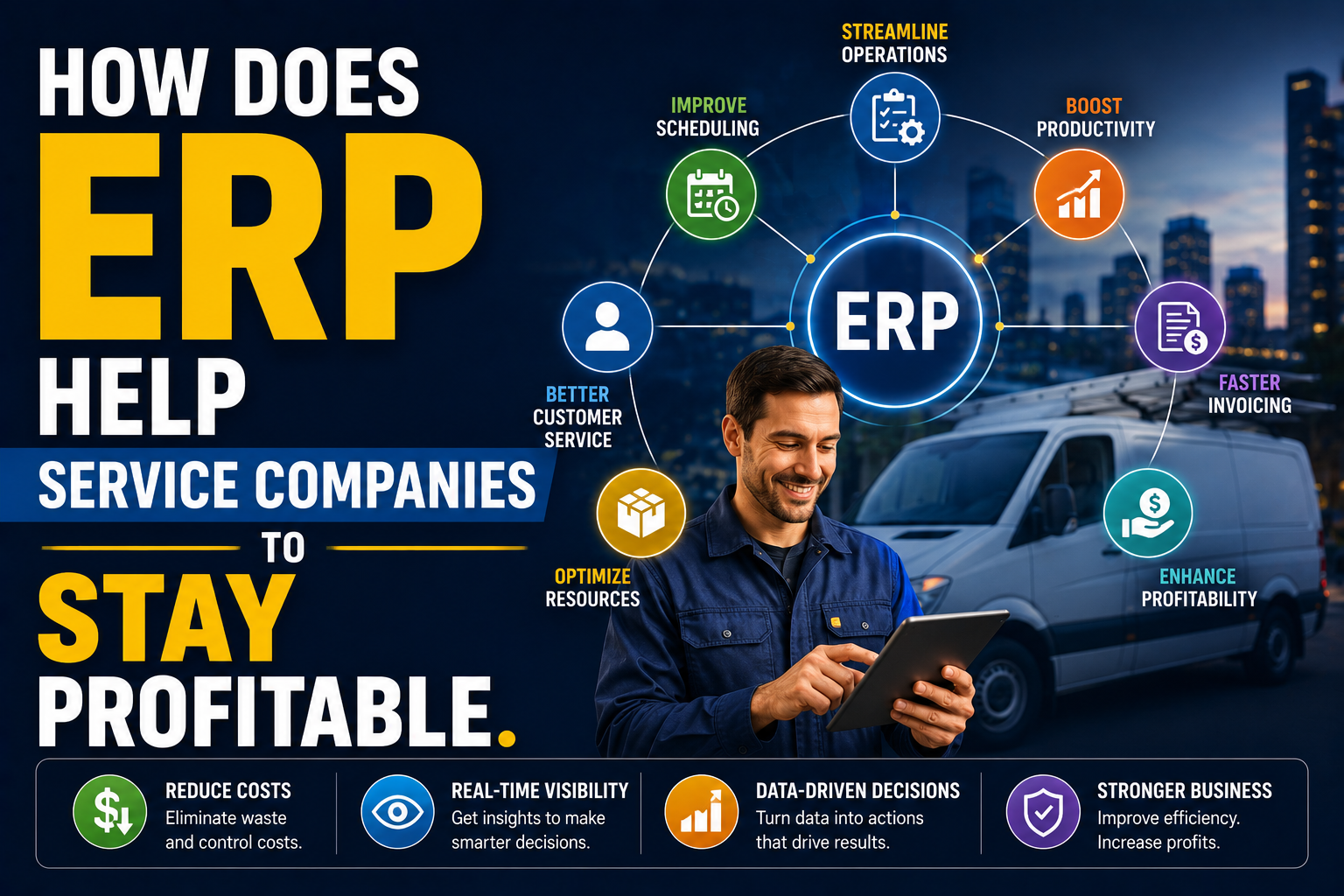
ERP (Enterprise Resource Planning) systems help service companies stay profitable by giving them better visibility, control, and efficiency across their operations. Unlike product-based businesses, service companies sell time, expertise, and resources, making it critical to manage utilization, costs, and customer relationships effectively.
1. Improved Resource Utilization A service company's biggest asset is its people. ERP systems help managers:
- Track employee availability and workloads
- Schedule staff efficiently
- Match skills to projects
- Reduce idle time and over-allocation
When consultants, technicians, accountants, or engineers spend more billable hours on client work, profitability increases. Example: A consulting firm can identify underutilized consultants and assign them to revenue-generating projects before bench time becomes costly.
2. Better Project Cost Control Many service companies lose money because they don't accurately track project costs. ERP systems help monitor:
- Labor costs
- Travel expenses
- Subcontractor costs
- Materials used
- Project budgets
Managers can compare actual costs against budgets in real time and take corrective action before projects become unprofitable.
3. Accurate Time and Expense Tracking ERP systems enable employees to record:
- Time spent on projects
- Billable hours
- Expenses incurred
Benefits include:
- More accurate invoicing
- Reduced revenue leakage
- Faster billing cycles
- Improved cash flow
Even small amounts of unrecorded time can significantly impact annual profits.
4. Faster and More Accurate Invoicing Delayed invoicing often delays payment. ERP systems can automatically generate invoices from:
- Approved timesheets
- Project milestones
- Service contracts
- Completed work orders
This reduces administrative effort and speeds up collections.
5. Enhanced Cash Flow Management Cash flow is often the biggest challenge for service businesses. ERP provides visibility into:
- Outstanding invoices
- Customer payment history
- Upcoming expenses
- Revenue forecasts
Managers can identify potential cash shortages early and make informed financial decisions.
6. Better Customer Relationship Management Many ERP solutions integrate CRM functionality. This allows companies to track:
- Leads and opportunities
- Customer communications
- Service requests
- Contract renewals
Better customer service improves retention, and retaining existing clients is usually more profitable than acquiring new ones.
7. Real-Time Profitability Analysis ERP systems provide insights into profitability by:
- Customer
- Project
- Service line
- Department
- Consultant or technician
This helps management identify:
- High-margin services
- Unprofitable customers
- Underperforming projects
Decisions can then be based on data rather than assumptions.
8. Improved Forecasting and Planning ERP systems help companies forecast:
- Revenue
- Resource requirements
- Capacity needs
- Future workloads
Better forecasting reduces the risk of over-hiring or under-staffing and improves long-term profitability.
9. Reduced Administrative Costs Automation reduces manual work in areas such as:
- Data entry
- Timesheet processing
- Expense management
- Procurement
- Financial reporting
Employees spend less time on administration and more time on value-adding activities.
10. Stronger Contract and Service Management For businesses with recurring contracts or service agreements, ERP helps manage:
- Service level agreements (SLAs)
- Contract renewals
- Recurring billing
- Customer entitlements
This reduces missed revenue opportunities and improves customer satisfaction.
11. Better Decision-Making Through Reporting ERP systems provide dashboards and reports showing:
- Utilization rates
- Project margins
- Revenue trends
- Employee productivity
- Accounts receivable aging
Management can quickly identify issues and act before they impact profitability.
Example: Professional Services Firm Without ERP:
- Consultants forget to capture billable hours.
- Project costs are tracked in spreadsheets.
- Invoices are delayed.
- Management only discovers project overruns after completion.
With ERP:
- Time and expenses are captured daily.
- Project budgets are monitored in real time.
- Invoices are generated automatically.
- Managers see project profitability immediately.
The result is higher billable utilization, faster cash collection, and improved profit margins.
Key Takeaway ERP helps service companies stay profitable by ensuring that people, projects, finances, and customer relationships are managed efficiently. The biggest benefits typically come from:
- Higher billable utilization
- Better project cost control
- Faster invoicing and cash collection
- Improved visibility into profitability
- More informed business decisions
For service organizations, profitability often depends on managing time and resources effectively, and an ERP system provides the visibility and control needed to do that consistently.