Business Intelligence: Turning Data Into Better Business Decisions
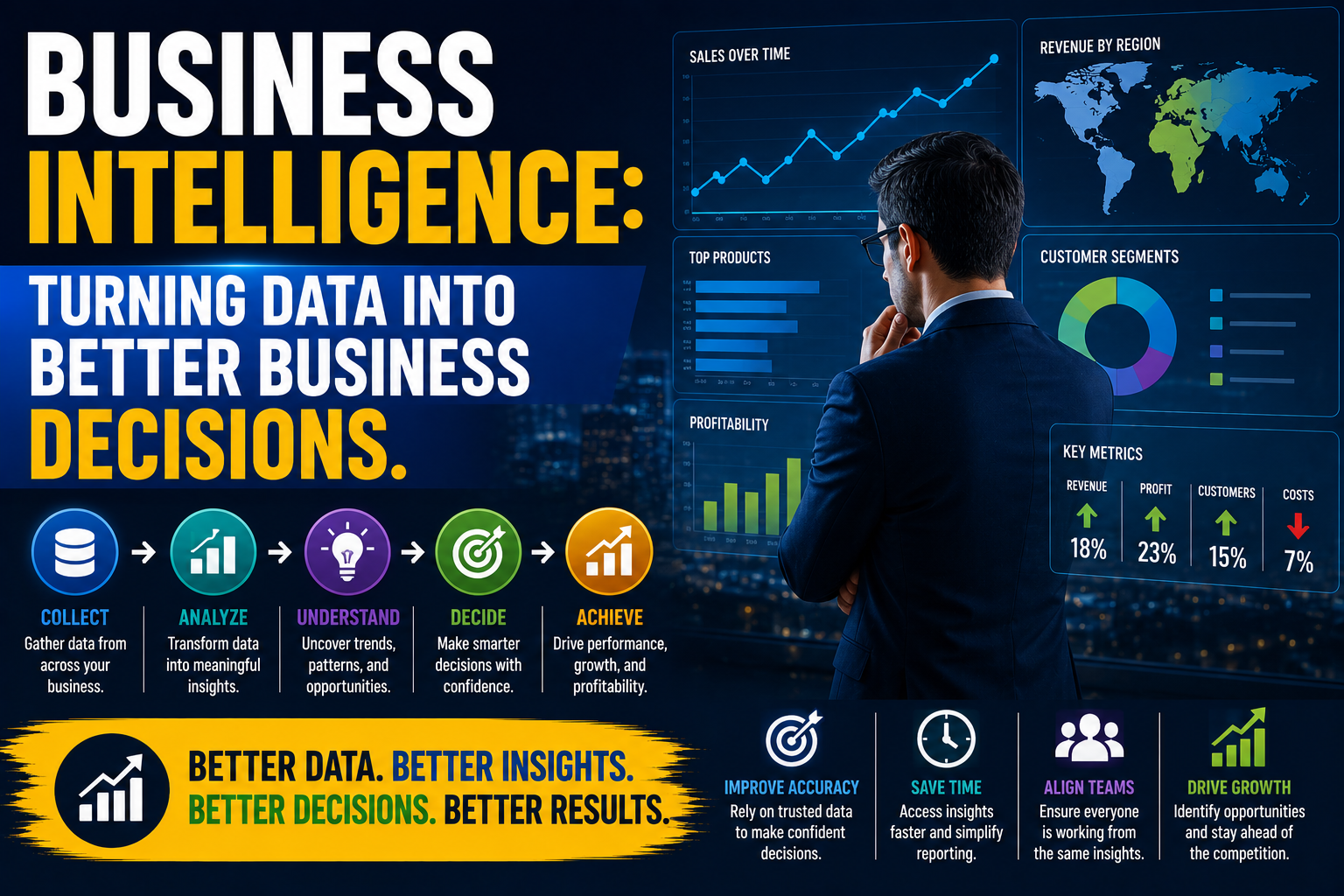
Every business generates data. Sales transactions, customer interactions, inventory movements, financial records, and operational activities all produce valuable information every day. The challenge is not collecting data—it's turning that data into meaningful insights. This is where Business Intelligence (BI) plays a critical role. Business Intelligence helps organizations transform raw data into actionable information that supports smarter decision-making, improves performance, and drives growth.
What Is Business Intelligence? Business Intelligence refers to the processes, technologies, and tools used to collect, analyse, and present business data in a meaningful way. BI enables organizations to:
- Monitor performance
- Identify trends
- Measure key metrics
- Improve forecasting
- Support strategic planning
Rather than relying on intuition alone, businesses can make decisions based on accurate and timely information.
Why Business Intelligence Matters Many organizations struggle with information scattered across spreadsheets, reports, and multiple systems. As a result, managers often spend more time gathering data than acting on it. Business Intelligence provides a centralized view of business performance, allowing leaders to quickly answer questions such as:
- Which products are most profitable?
- What is our current cash position?
- Which customers generate the highest revenue?
- Are sales targets being achieved?
- Where are operational inefficiencies occurring?
Access to these insights enables faster and more confident decision-making.
1. Improved Visibility Across the Business One of the greatest benefits of BI is real-time visibility. Business Intelligence dashboards can provide instant access to:
- Sales performance
- Financial results
- Inventory levels
- Production metrics
- Customer activity
- Operational KPIs
Instead of waiting for month-end reports, decision-makers can monitor performance as it happens.
2. Better Financial Management Financial data is at the heart of every business decision. Business Intelligence helps organizations:
- Monitor revenue and profitability
- Track cash flow
- Analyse expenses
- Identify cost-saving opportunities
- Compare actual performance against budgets
This level of visibility helps businesses improve financial control and make informed investment decisions.
3. Stronger Sales and Customer Insights Understanding customer behaviour is essential for growth. BI tools can reveal:
- Top-performing customers
- Buying patterns
- Sales trends
- Customer retention rates
- Product performance
These insights help sales teams focus on high-value opportunities and improve customer relationships.
4. Improved Inventory Management Inventory challenges can have a significant impact on profitability. Business Intelligence helps businesses:
- Monitor stock levels
- Identify slow-moving inventory
- Track inventory turnover
- Forecast demand
- Reduce stock shortages
By improving inventory visibility, organizations can optimize working capital and improve customer service.
5. Enhanced Operational Efficiency BI helps businesses identify inefficiencies that may otherwise go unnoticed. Examples include:
- Production bottlenecks
- Excessive downtime
- Delayed order processing
- Poor resource utilization
- Inefficient workflows
With clear visibility into operations, businesses can take corrective action and improve performance.
6. Better Forecasting and Planning Business Intelligence allows organizations to analyse historical trends and predict future outcomes. This supports:
- Sales forecasting
- Budget planning
- Resource allocation
- Inventory planning
- Capacity management
Accurate forecasting helps businesses prepare for growth and reduce uncertainty.
7. Faster Decision-Making In today's business environment, speed matters. Organizations that can access information quickly are better positioned to:
- Respond to market changes
- Address operational challenges
- Identify opportunities
- Manage risks
BI dashboards provide immediate access to critical information, reducing the time required to gather and analyse data.
Common Business Intelligence Metrics Businesses often track KPIs such as: Financial
- Revenue
- Gross Profit Margin
- Net Profit Margin
- Cash Flow
- Accounts Receivable Aging
Sales
- Sales Growth
- Conversion Rates
- Average Order Value
- Customer Retention
Inventory
- Inventory Turnover
- Stock Availability
- Inventory Value
- Slow-Moving Stock
Operations
- Production Efficiency
- Order Fulfilment Time
- On-Time Delivery Rate
- Resource Utilization
Monitoring these metrics helps businesses measure performance and identify areas for improvement.
The Role of ERP in Business Intelligence ERP systems provide the foundation for effective Business Intelligence by consolidating data from across the organization. An ERP system integrates:
- Finance
- Sales
- Inventory
- Purchasing
- Manufacturing
- Customer Service
This creates a single source of truth that supports accurate reporting and analytics. Modern ERP solutions often include built-in dashboards and reporting tools that enable businesses to gain real-time insights without relying on multiple disconnected systems.
Signs Your Business Needs Better Business Intelligence You may benefit from a BI strategy if: ✔ Reports take too long to prepare
✔ Information is spread across multiple systems
✔ Decisions rely heavily on spreadsheets
✔ Management lacks real-time visibility
✔ Different departments report different numbers
✔ Forecasting is difficult or inaccurate
✔ Growth is increasing operational complexity These are often indicators that the business needs stronger reporting and analytics capabilities.
The Bottom Line Business Intelligence is not just about reporting—it is about transforming data into actionable insights that improve decision-making and business performance. Organizations that leverage Business Intelligence gain greater visibility, improve efficiency, reduce risk, and identify opportunities for growth more quickly than their competitors. In an increasingly data-driven world, businesses that can turn information into insight gain a significant competitive advantage. The goal is not simply to collect data, but to use it to make smarter, faster, and more profitable decisions.