Why SME’s Need ERP
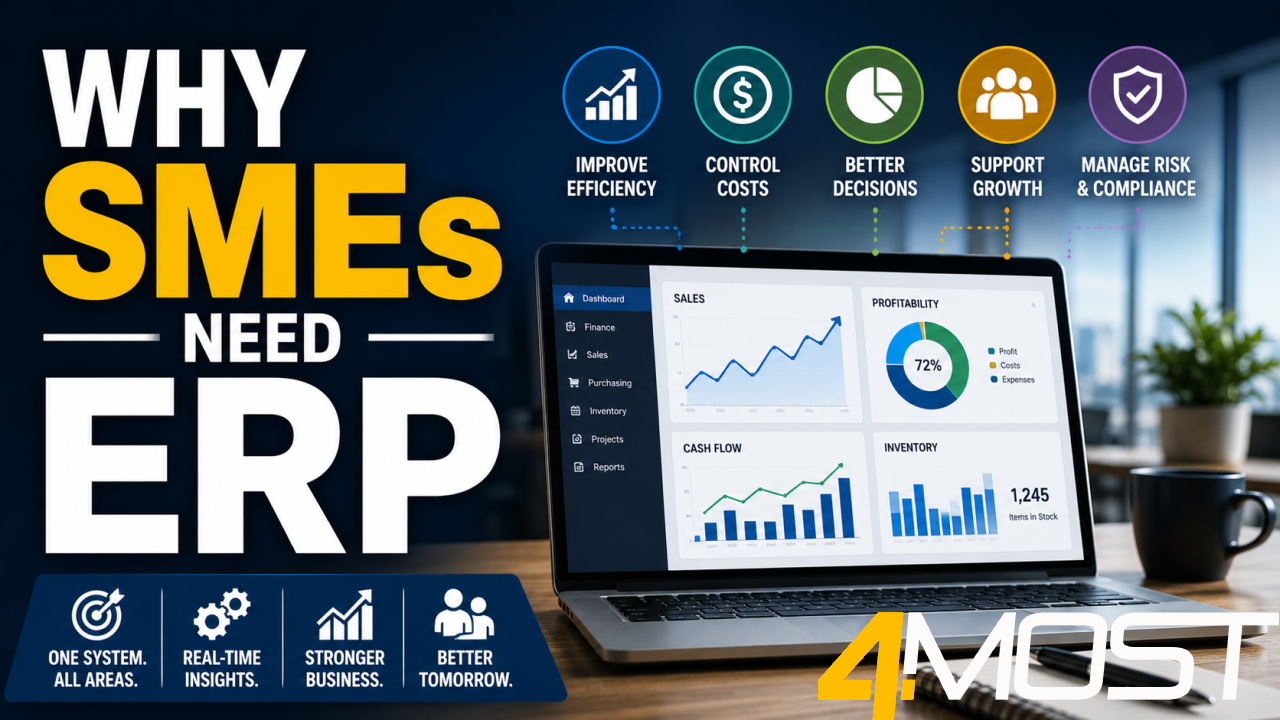
Small and medium-sized enterprises (SMEs) often start with accounting software, spreadsheets, and disconnected applications. While these tools may work initially, they can become barriers to growth as the business expands. An Enterprise Resource Planning (ERP) system brings all your critical business processes together into one integrated platform.
Here are the key reasons why SMEs need an ERP system.
1. One Source of Truth
An ERP system centralises your business data in a single database. Instead of managing information across multiple spreadsheets and applications, everyone works from the same real-time data.
Benefits:
- Improved accuracy
- Better collaboration
- Elimination of duplicate data
- Faster access to information
2. Increased Productivity Manual processes consume valuable time and increase the risk of errors.
An ERP system automates routine tasks such as:
- Sales order processing
- Purchasing
- Inventory updates
- Financial postings
- Customer invoicing
- Reporting
Result:
Employees spend less time on administration and more time serving customers and growing the business.
3. Better Decision-Making
Successful businesses rely on accurate, up-to-date information.
ERP dashboards provide real-time visibility into:
- Sales performance
- Profit margins
- Cash flow
- Inventory levels
- Customer activity
- Business trends
Managers can make informed decisions based on live data rather than outdated reports.
4. Improved Financial Control
An ERP system integrates all financial transactions into one platform.
This enables businesses to:
- Monitor cash flow
- Control expenses
- Automate reconciliations
- Produce financial reports quickly
- Meet tax and compliance requirements
Finance teams spend less time gathering information and more time analysing business performance.
5. Better Customer Service Customers expect fast, accurate service.
With an ERP system, employees can instantly access:
- Customer history
- Open orders
- Stock availability
- Delivery status
- Outstanding balances
This leads to quicker responses, fewer mistakes, and higher customer satisfaction.
6. Supports Business Growth
As SMEs grow, operations become more complex.
An ERP system is designed to scale with your business by supporting:
- More users
- More customers
- Additional branches
- Multiple warehouses
- International operations
- New product lines
Rather than replacing systems as your business grows, ERP grows with you.
7. Reduces Operating Costs
Automation and better visibility help reduce unnecessary costs by:
- Minimising inventory waste
- Preventing duplicate purchases
- Reducing manual administration
- Improving resource utilisation
- Lowering operational errors
These efficiencies contribute directly to improved profitability.
Why SAP Business One?
SAP Business One is built specifically for small and medium-sized businesses. It combines finance, sales, purchasing, inventory, customer relationship management (CRM), production, and reporting into one integrated solution.
Key advantages include:
- Designed for growing SMEs
- Affordable and scalable
- Cloud or on-premise deployment
- Real-time business insights
- Industry-specific functionality
- Extensive integration capabilities
It provides the tools SMEs need today while supporting future growth.
The Bottom Line
An ERP system is no longer a luxury reserved for large enterprises. It is a strategic investment that helps SMEs improve efficiency, gain better control, and prepare for long-term growth.
By replacing disconnected systems with one integrated platform, SMEs can:
- Increase productivity
- Improve customer service
- Make faster decisions
- Reduce costs
- Scale with confidence
For growing businesses, an ERP system is the foundation for sustainable success.