Slow business decisions
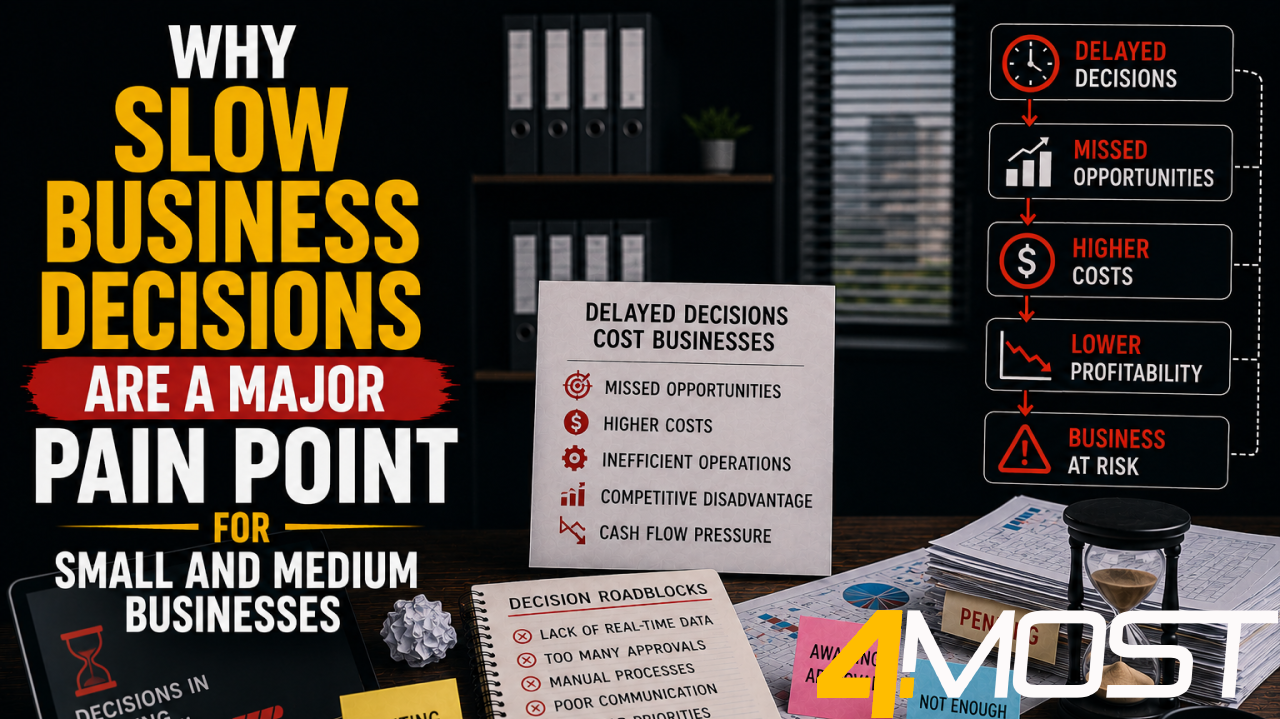
Slow business decision-making is one of the most significant barriers to growth for small and medium-sized businesses (SMBs) in Southern Africa. In today's business environment, market conditions can change rapidly due to economic uncertainty, exchange rate fluctuations, inflation, supply chain disruptions, and changing customer demands. Businesses that cannot make timely decisions often lose opportunities, increase costs, and fall behind more agile competitors.
For many SMEs, slow decisions are not caused by a lack of capable managers—they are caused by delayed information, manual processes, disconnected systems, and lengthy approval procedures. The ability to make fast, informed decisions has become a competitive advantage.
Why Slow Business Decisions Are a Major Pain Point
1. Management Lacks Real-Time Information
Many business owners wait until month-end to receive reports. By then, it may be too late to respond to:
- Falling sales
- Rising costs
- Cash flow problems
- Inventory shortages
- Customer complaints
Impact:
- Problems become larger before they are addressed.
- Opportunities are missed.
- Business performance suffers.
2. Information Is Scattered Across Multiple Systems
Many SMEs store information in:
- Excel spreadsheets
- Accounting software
- Separate inventory systems
- Paper files
Managers often spend hours gathering information before they can make a decision. This delays action and increases the likelihood of errors.
3. Manual Reporting Takes Too Long
Finance and operations teams frequently spend days:
- Consolidating spreadsheets
- Reconciling data
- Preparing management reports
- Correcting errors
Instead of analysing information and supporting decision-making.
4. Approval Processes Are Slow
Important decisions often wait for:
- Paper signatures
- Email approvals
- Multiple management reviews
- Employees returning from travel
Delays affect:
- Purchasing
- Customer quotations
- Supplier payments
- Expense approvals
- Credit approvals
Customers and suppliers increasingly expect faster responses.
5. Market Conditions Change Quickly
Southern African businesses operate in an environment affected by:
- Inflation
- Exchange rate fluctuations
- Rising fuel costs
- Electricity disruptions
- Supply chain uncertainty
Businesses that cannot respond quickly may:
- Lose profitability
- Miss sales opportunities
- Carry the wrong inventory
- Make poor purchasing decisions
6. Customer Expectations Continue to Increase
Customers expect businesses to respond quickly to:
- Quotations
- Orders
- Service requests
- Complaints
- Delivery enquiries
Slow decisions often result in:
- Lost sales
- Customer dissatisfaction
- Reduced loyalty
7. Opportunities Are Missed
Delayed decision-making can prevent businesses from taking advantage of:
- Supplier discounts
- New market opportunities
- Seasonal demand
- Investment opportunities
- Strategic partnerships
Competitors that move faster often capture these opportunities first.
8. Risks Are Not Addressed Early
Businesses need to identify issues before they become critical. Slow decision-making delays responses to:
- Declining cash flow
- Inventory shortages
- Customer payment delays
- Cost overruns
- Project risks
Early intervention is almost always less expensive than reacting after problems escalate.
9. Employees Become Less Productive
When employees wait for decisions, work slows down. Examples include:
- Waiting for purchase approvals
- Delayed customer quotations
- Pending project decisions
- Unapproved expenses
This creates bottlenecks that reduce productivity throughout the organisation.
10. Growth Becomes Harder to Manage
As businesses expand:
- More employees are involved.
- More transactions occur.
- More decisions are required.
- Operations become increasingly complex.
Without efficient decision-making processes, growth can create bureaucracy instead of improved performance. What Southern African SMEs Can Do About It
1. Use Real-Time Business Information
Managers should have immediate access to key business information, including:
- Sales performance
- Cash flow
- Inventory levels
- Customer balances
- Operating expenses
- Project status
Real-time visibility allows problems and opportunities to be identified as they happen.
2. Centralise Business Data
Replace disconnected spreadsheets and systems with a single source of business information. When finance, sales, purchasing, inventory, and operations share the same data:
- Decisions become faster.
- Information becomes more reliable.
- Departments collaborate more effectively.
3. Automate Routine Decisions
Not every decision requires management intervention. Automate activities such as:
- Inventory reorder points
- Payment reminders
- Standard approval workflows
- Customer notifications
- Scheduled reporting
Automation frees managers to focus on strategic decisions.
4. Streamline Approval Processes
Review approval workflows and eliminate unnecessary steps. Use digital approvals for:
- Purchase orders
- Expense claims
- Customer discounts
- Credit applications
- Supplier payments
Clear approval limits allow routine decisions to be made quickly while maintaining appropriate controls.
5. Monitor Key Performance Indicators (KPIs)
Create dashboards that display metrics such as:
- Revenue
- Gross profit
- Cash position
- Debtor ageing
- Inventory turnover
- Customer satisfaction
- Project profitability
Regular monitoring allows management to respond before small issues become major problems.
6. Empower Employees
Define clear decision-making authority so employees can resolve routine matters without waiting for senior management. Examples include:
- Customer service resolutions
- Routine purchasing
- Inventory transfers
- Standard pricing decisions
Empowered employees improve responsiveness while reducing management bottlenecks.
7. Improve Communication
Encourage regular communication between:
- Sales
- Finance
- Operations
- Purchasing
- Customer service
Shared information leads to faster, better-informed decisions.
8. Build a Data-Driven Culture
Encourage managers to base decisions on:
- Performance data
- Customer trends
- Financial analysis
- Operational KPIs
Rather than relying solely on assumptions or past experience.
9. Invest in an Integrated ERP Solution
An ERP solution such as SAP Business One enables faster, more informed decision-making by providing:
- Real-time dashboards
- Live financial reporting
- Integrated sales, purchasing, inventory, production, and CRM
- Automated workflows and approvals
- Cash flow visibility
- Inventory availability across warehouses
- Customer and supplier performance reporting
- Profitability analysis
- Drill-down capability from summary dashboards to individual transactions
Instead of waiting for manually prepared reports, business leaders can access accurate, up-to-date information whenever they need it. This allows them to respond quickly to changing market conditions, customer needs, and operational issues.
The Business Benefits
Businesses that improve decision-making speed typically achieve:
- Faster responses to market changes
- Improved cash flow management
- Better customer service
- Increased sales opportunities
- Lower operating costs
- Improved inventory control
- Higher employee productivity
- Better risk management
- Greater organisational agility
- Stronger long-term competitiveness
Conclusion
Slow business decisions are not simply an operational inconvenience—they can reduce profitability, delay growth, and weaken competitiveness. In Southern Africa's dynamic business environment, where economic conditions, customer expectations, and supply chains can change quickly, the ability to make timely, informed decisions is essential.
By centralising business information, automating routine workflows, empowering employees, monitoring key performance indicators, and implementing an integrated ERP solution such as SAP Business One, SMEs can transform decision-making from a reactive process into a strategic advantage. Faster decisions lead to quicker responses, better customer experiences, stronger financial performance, and a business that is better prepared to adapt and grow.