Skills shortages
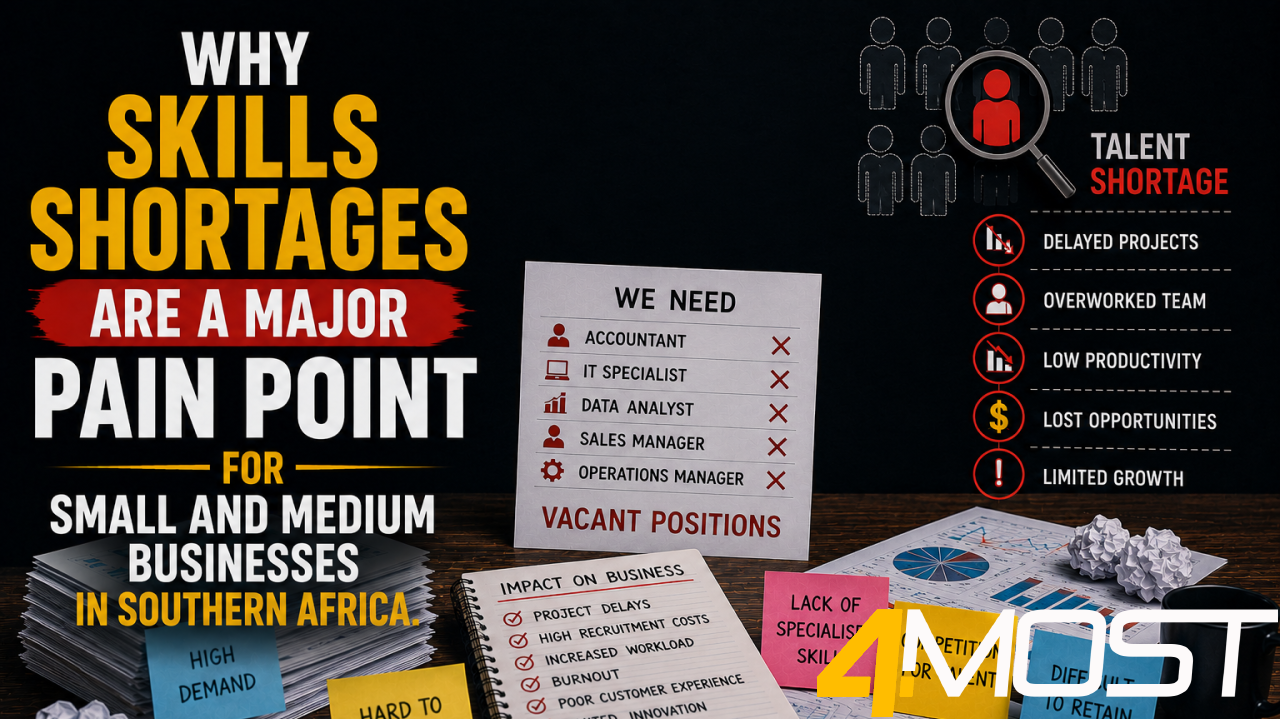
Skills shortages are one of the most persistent challenges facing small and medium-sized businesses (SMBs) across Southern Africa. Finding and retaining qualified employees has become increasingly difficult due to emigration of experienced professionals, competition from larger companies, evolving technology, and a growing demand for specialised skills.
For many SMEs, the problem is not simply a lack of people—it is a lack of people with the right skills. This affects productivity, customer service, innovation, compliance, and the ability to grow. Businesses that successfully address skills shortages often gain a significant competitive advantage.
Why Skills Shortages Are a Major Pain Point1. Difficulty Recruiting Qualified Employees
Many SMEs struggle to recruit experienced professionals in areas such as:
- Finance
- IT
- Engineering
- Sales
- Production
- Supply chain management
Larger organisations often attract top talent by offering higher salaries, more benefits, and greater career development opportunities.
Impact:
- Vacant positions remain unfilled
- Increased workload for existing staff
- Delayed business growth
2. Rising Labour Costs
Competition for skilled employees continues to increase salaries and recruitment costs. Businesses may need to spend more on:
- Recruitment agencies
- Higher salaries
- Employee benefits
- Retention incentives
- Training programmes
These costs place additional pressure on profitability.
3. Existing Employees Become Overloaded
When key positions cannot be filled, existing employees often take on additional responsibilities. This can result in:
- Burnout
- Lower productivity
- Increased mistakes
- Reduced employee morale
- Higher staff turnover
A small skills gap can quickly become a larger operational problem.
4. Customer Service Suffers
Skills shortages can lead to:
- Slower response times
- Longer project delivery periods
- Reduced product quality
- Delayed support
- Increased customer complaints
Customers generally judge businesses by outcomes, not by the staffing challenges behind them.
5. Innovation Slows Down
Employees who are fully occupied with day-to-day operations have little time to:
- Improve processes
- Develop new products
- Adopt new technologies
- Explore new markets
Skills shortages often force businesses to focus on survival rather than innovation.
6. Technology Adoption Becomes More Difficult
Modern business technologies such as ERP systems, cloud platforms, automation, artificial intelligence, and business analytics require employees with appropriate technical skills. Without these capabilities, businesses may:
- Delay digital transformation
- Underutilise technology investments
- Continue relying on inefficient manual processes
7. Knowledge Is Concentrated in a Few Individuals
Many SMEs depend heavily on one or two experienced employees. If those individuals leave, retire, or become unavailable, the business may lose:
- Operational knowledge
- Customer relationships
- Technical expertise
- Critical business processes
This creates significant operational risk.
8. Compliance and Governance Become More Challenging
Skilled employees are essential for areas such as:
- Financial reporting
- Tax compliance
- Payroll
- Health and safety
- Quality management
- Data protection
Skills shortages increase the risk of costly errors and non-compliance. 9.
Growth Is Limited Business expansion often requires additional expertise in:
- Sales
- Operations
- Finance
- Project management
- Customer support
Without the right people, businesses may delay expansion or struggle to maintain service quality as they grow.
10. Employee Turnover Has a Greater Impact
When experienced employees leave, SMEs often experience:
- Loss of institutional knowledge
- Recruitment delays
- Higher onboarding costs
- Reduced productivity during transitions
Replacing experienced employees can take months, during which business performance may suffer.
What Southern African SMEs Can Do About It
1. Invest in Employee Development
Training existing employees is often more cost-effective than constantly recruiting new ones. Focus on:
- Technical skills
- Leadership development
- Customer service
- Digital literacy
- Financial and operational knowledge
Continuous learning strengthens both employees and the business.
2. Create Knowledge-Sharing Processes
Reduce dependence on individuals by documenting:
- Standard operating procedures
- Customer processes
- Technical instructions
- Best practices
Encourage mentoring so experienced employees transfer knowledge to others.
3. Automate Routine Work
Automation allows employees to focus on higher-value activities rather than repetitive administration. Examples include:
- Invoice processing
- Bank reconciliation
- Purchase approvals
- Inventory updates
- Report generation
Automation helps businesses achieve more without proportionally increasing staff.
4. Improve Employee Retention
Retaining experienced employees is usually less expensive than replacing them. Strategies include:
- Career development opportunities
- Recognition and rewards
- Flexible working arrangements where practical
- Positive workplace culture
- Clear communication and leadership
Employees who feel valued are more likely to stay.
5. Cross-Train Employees
Ensure multiple employees understand critical business processes. Cross-training improves resilience by:
- Reducing dependence on one individual
- Improving business continuity
- Increasing workforce flexibility
It also creates development opportunities for staff.
6. Recruit for Potential, Not Just Experience
Where experienced candidates are scarce, consider hiring people with strong aptitude and investing in structured training. A willingness to learn and adapt can be as valuable as years of experience.
7. Partner with Educational Institutions Collaborate with:
- Universities
- Technical colleges
- Apprenticeship programmes
- Industry associations
Internships and graduate programmes can help build a future talent pipeline.
8. Use Data to Improve Workforce Planning
Analyse workforce information such as:
- Skills gaps
- Training needs
- Productivity levels
- Staff turnover
- Future resource requirements
Planning ahead reduces the impact of unexpected vacancies.
9. Invest in an Integrated ERP Solution
An ERP solution such as SAP Business One helps businesses reduce the impact of skills shortages by making employees more productive rather than simply adding more staff. It enables organisations to:
- Automate repetitive business processes
- Standardise workflows across departments
- Reduce manual data entry
- Provide real-time access to business information
- Guide employees through structured approval processes
- Improve collaboration between finance, sales, purchasing, inventory, production, and service teams
- Deliver dashboards that help managers make informed decisions quickly
With integrated systems and automated workflows, new employees can become productive more quickly, experienced staff spend less time on administration, and valuable organisational knowledge is embedded in business processes rather than residing only with individuals.
The Business Benefits
Businesses that proactively address skills shortages typically achieve:
- Higher employee productivity
- Lower staff turnover
- Faster onboarding of new employees
- Better customer service
- Reduced dependence on key individuals
- Greater operational efficiency
- Improved compliance and governance
- Stronger innovation capability
- Better use of technology investments
- A more scalable business prepared for growth
Conclusion
Skills shortages are one of the defining challenges facing Southern African SMEs. Limited access to experienced talent, rising labour costs, and increasing technological complexity make it difficult for businesses to compete and grow. However, the solution is not simply hiring more people—it is building a more capable, productive, and resilient workforce.
By investing in employee development, sharing knowledge, cross-training teams, improving retention, automating routine work, and implementing an integrated ERP solution such as SAP Business One, businesses can reduce the impact of skills shortages while improving productivity, service quality, and long-term competitiveness. In a market where skilled people are scarce, enabling every employee to contribute more effectively becomes a powerful competitive advantage.