Scaling operations efficiently
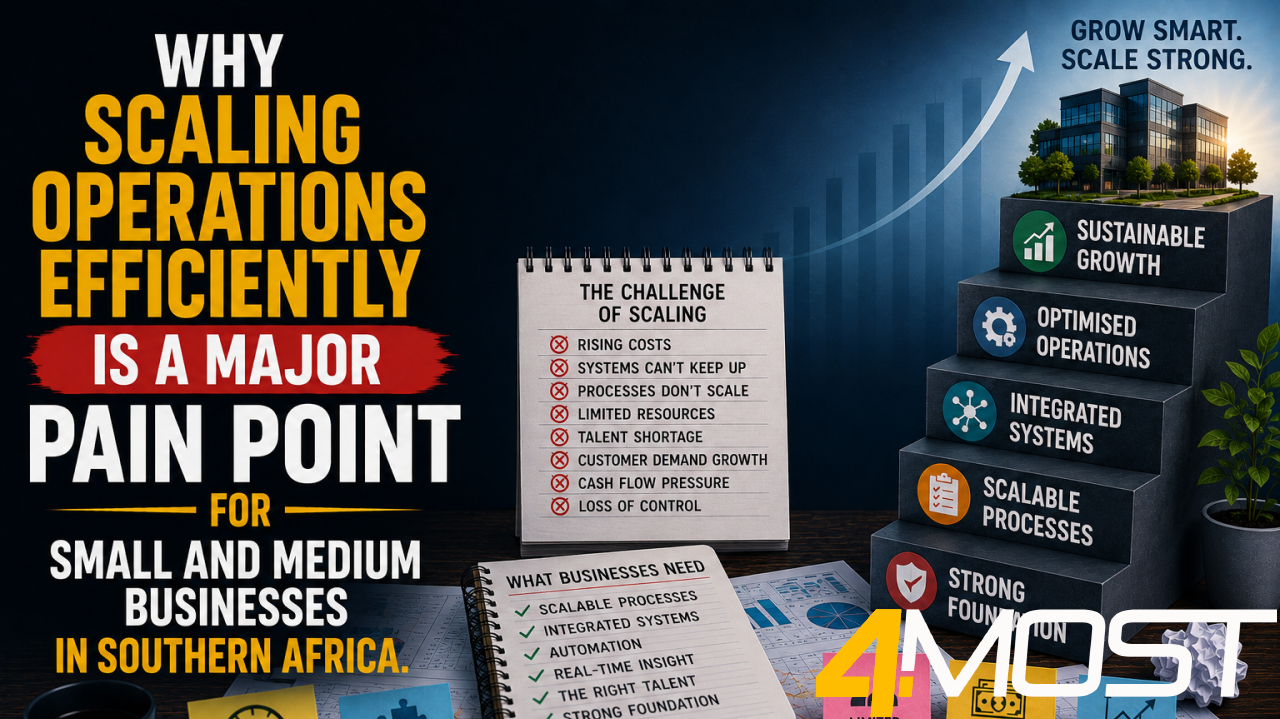
Scaling operations efficiently is one of the greatest challenges facing small and medium-sized businesses (SMBs) in Southern Africa. Growth is a positive sign of success, but it also introduces greater complexity. More customers, employees, suppliers, products, and transactions place increasing demands on business processes, systems, and management.
Many SMEs reach a point where the methods that supported their early growth—manual processes, spreadsheets, and disconnected systems—can no longer keep up. Instead of growth making the business stronger, it creates bottlenecks, rising costs, declining service levels, and operational inefficiencies.
The businesses that scale successfully are those that build systems and processes capable of supporting growth without proportionally increasing costs.
Why Scaling Operations Efficiently Is a Major Pain Point
1. Manual Processes Cannot Keep Up
Processes that worked when the business had:
- 50 customers
- 5 employees
- 100 monthly transactions
often become unmanageable when the business grows to:
- Thousands of customers
- Multiple branches
- Hundreds of daily transactions
Impact:
- Administrative bottlenecks
- More errors
- Slower response times
- Higher operating costs
2. Operating Costs Increase Faster Than Revenue
Many businesses discover that growth requires:
- More administrative staff
- Larger offices
- Additional supervisors
- More manual reporting
- More paperwork
If costs grow faster than revenue, profitability declines despite increased sales.
3. Business Complexity Increases
Growth usually means managing:
- More products
- More suppliers
- More customers
- More employees
- More warehouses
- More projects
Without structured systems, complexity quickly becomes difficult to control.
4. Customer Service Becomes Inconsistent
As transaction volumes increase, businesses often struggle to maintain:
- Fast response times
- Accurate deliveries
- Reliable communication
- Personalised customer service
Poor service during periods of growth can result in customer churn.
5. Management Loses Visibility
Business owners who previously knew every customer and transaction can no longer oversee every detail. Without real-time information, it becomes difficult to answer questions such as:
- Which branch is most profitable?
- Which products are growing fastest?
- Where are operational bottlenecks?
- Which customers generate the highest margins?
Losing visibility makes managing growth significantly harder.
6. Employees Become Less Productive
As businesses expand, employees often spend more time:
- Coordinating activities
- Searching for information
- Updating spreadsheets
- Resolving errors
- Following up on approvals
Instead of increasing productivity, growth creates additional administration.
7. Cash Flow Comes Under Pressure
Growth usually requires additional investment in:
- Inventory
- Equipment
- Vehicles
- Employees
- Marketing
- Working capital
Without careful planning, growing businesses can experience cash flow shortages despite increasing sales.
8. Systems Fail to Scale
Many SMEs rely on:
- Excel spreadsheets
- Entry-level accounting software
- Stand-alone inventory systems
- Manual reporting
As transaction volumes grow, these systems become slower, less reliable, and more difficult to manage.
9. Decision-Making Slows Down
More employees and more complex operations often result in:
- Longer approval processes
- More meetings
- Delayed reporting
- Slower communication
Businesses become less agile just when speed becomes more important.
10. Growth Increases Risk
Rapid expansion can expose weaknesses in:
- Financial controls
- Inventory management
- Customer service
- Compliance
- Cybersecurity
- Project management
Without scalable processes, operational risks increase alongside business growth. What Southern African SMEs Can Do About It
1. Standardise Business Processes
Document and standardise key processes for:
- Sales
- Purchasing
- Inventory management
- Customer service
- Finance
- Project management
Consistent processes make it easier to train employees, maintain quality, and support expansion.
2. Automate Repetitive Tasks
Automation allows businesses to handle higher transaction volumes without adding equivalent administrative resources. Examples include:
- Customer invoicing
- Purchase approvals
- Inventory replenishment
- Financial reporting
- Payment reminders
- Workflow approvals
Automation improves both efficiency and accuracy.
3. Invest in Scalable Technology
Choose systems that can support future growth rather than only current requirements. Scalable technology should accommodate:
- More users
- Multiple locations
- Additional warehouses
- Higher transaction volumes
- New business units
This avoids costly system replacements as the business grows.
4. Improve Operational Visibility
Use real-time dashboards to monitor:
- Sales
- Cash flow
- Inventory
- Profitability
- Customer performance
- Operational KPIs
Better visibility enables managers to identify bottlenecks and respond quickly.
5. Strengthen Financial Planning
Growth requires careful management of:
- Working capital
- Cash flow
- Budgets
- Capital expenditure
- Profitability
Regular forecasting helps ensure that growth remains financially sustainable.
6. Develop Employees
As businesses grow, employees need greater responsibility. Invest in:
- Leadership development
- Technical skills
- Process training
- Cross-functional knowledge
A capable workforce supports sustainable expansion.
7. Delegate Decision-Making
Avoid creating bottlenecks by empowering managers and supervisors with clear authority to make routine operational decisions. This enables faster responses while allowing senior leaders to focus on strategic priorities.
8. Measure Performance Continuously
Monitor KPIs such as:
- Revenue per employee
- Gross profit margin
- Inventory turnover
- Customer retention
- Order fulfilment time
- Operating cost ratio
Tracking performance ensures growth remains profitable, not just larger.
9. Invest in an Integrated ERP Solution
An ERP solution such as SAP Business One provides the foundation for scalable growth by integrating all major business functions into a single platform.
It enables businesses to:
- Automate business processes
- Manage multiple branches and warehouses
- Track inventory in real time
- Improve purchasing and supply chain management
- Monitor cash flow and profitability
- Manage projects and service operations
- Standardise workflows across the organisation
- Provide management with real-time dashboards and reporting
Because finance, sales, purchasing, inventory, production, CRM, and service management are fully integrated, businesses can grow without creating disconnected systems or significantly increasing administrative overhead.
The Business Benefits
Businesses that scale efficiently typically achieve:
- Sustainable revenue growth
- Improved profit margins
- Higher employee productivity
- Better customer service
- Lower operating costs
- Stronger cash flow management
- Faster decision-making
- Greater operational consistency
- Improved resilience to market changes
- A stronger competitive position
Conclusion
Scaling a business is about more than increasing sales—it is about increasing capacity without losing efficiency, profitability, or customer satisfaction. For Southern African SMEs, rising costs, infrastructure challenges, skills shortages, and economic uncertainty make efficient scaling essential for long-term success.
By standardising processes, automating routine work, investing in scalable technology, strengthening financial planning, developing employees, and implementing an integrated ERP solution such as SAP Business One, businesses can grow with confidence. Rather than adding complexity with every new customer or transaction, they build a business that becomes stronger, more efficient, and more profitable as it expands.